
How to Search Alcona County Traffic Court Records
Alcona County does not run its own branded traffic portal. The documented public search path is the statewide MiCOURT case-search system, which the Michigan judiciary uses in place of a separate county site. Traffic is one of its case-type categories, so a citation, a plea, and a disposition can all be traced through the same tool. The public court-display page for the Alcona County Trial Court shows a slim set of columns: party name, time, hearing info, case number, and CTN.
Before you start, gather a few basics. The citation number is the cleanest key, but a driver name, a case year, or a driver license number can all narrow a broad result set. Case-number searches return one file. Name searches can return several, so a date of birth or a filing year helps you pick the right one.
- Open the statewide MiCOURT case display and choose the traffic case category.
- Enter the case number when you have it, or search by last name plus first name.
- Narrow the list by case year, case status, or driver license number if results run long.
- Review the case details, the court date, and the disposition shown for the citation.
- Pay the balance, request a hearing, or ask the district court counter for a certified copy.
Which Courts Handle Traffic Cases in Alcona County
Alcona County has no municipal court, county court at law, or justice-of-the-peace court in the official county materials. The 81st District Court is the trial court that handles traffic. It hears civil infractions, misdemeanor traffic charges, and local ordinance violations, and it takes the payments and hearing requests that follow.
The circuit court plays a narrow role. It handles driver-license appeals and other administrative matters that rise above the district court. The Michigan Secretary of State is not a court at all, yet it holds the driving record that traffic convictions feed into. The table sorts out who does what.
| Court or Office | Traffic Role | Location |
|---|---|---|
| 81st District Court | Civil infractions, misdemeanor traffic, ordinance violations, payments and hearings | 106 5th St., Harrisville, MI |
| 23rd Circuit Court | Driver-license appeals and related administrative review | 106 5th St., Harrisville, MI |
| Michigan Secretary of State | Driving record, points, and license status (not a court) | Statewide, no county office |
Types of Alcona County Traffic Cases
Traffic cases split into a few broad groups, and the group often decides how the case is handled. Most tickets are civil infractions that a driver can simply pay. Others are misdemeanors that carry a court date and, in some cases, the risk of jail. The district court records track each type the same way, with a citation number, a charge, and a final outcome.
- Moving violations - speeding, failure to yield, and similar civil infractions that add points on conviction.
- Non-moving and equipment - registration, lighting, and gear issues tied to the vehicle rather than the driving.
- Ordinance violations - local rules enforced through the district court in Harrisville.
- Commercial vehicle and CDL - charges against holders of a commercial driver license, which carry stricter rules.
- Misdemeanor traffic - serious charges such as driving on a suspended license that route to the criminal side.
What Alcona County Traffic Court Records Show
A traffic court file is the court's own record of the citation. It documents what the driver was cited for, when the case was heard, and how it ended. It is not a summary of a person's whole driving history. Points appear only when the court reports a compliance or conviction status, so the field can be blank while a case is still open.
The core fields stay consistent from one citation to the next. Reading them in order gives a clear picture of where a case stands and what, if anything, is still owed.
| Field | What It Shows |
|---|---|
| Citation Number | The unique number the officer assigned to the ticket. |
| Charge | The specific traffic offense the driver was cited for. |
| Statute Cited | The Michigan law or local ordinance section behind the charge. |
| Court Date | The scheduled hearing or appearance date for the case. |
| Disposition | The outcome, such as paid, dismissed, or found responsible. |
| Fine or Cost Balance | The amount still owed on the citation, if any. |
| Points or Compliance Status | Points or compliance detail when the court reports it. |
Requesting a State Driving Record
The court file answers questions about one citation. The state driving record answers questions about the whole license. When a driver, an employer, or an insurer needs the full history, that request goes to the Michigan Secretary of State, not to the district court. The non-account request runs on the BDVR-154 form.
The SOS forms hub collects the driver-record request and its instructions in one place. The Michigan Secretary of State forms library hosts the BDVR-154 alongside other driver and vehicle resources.
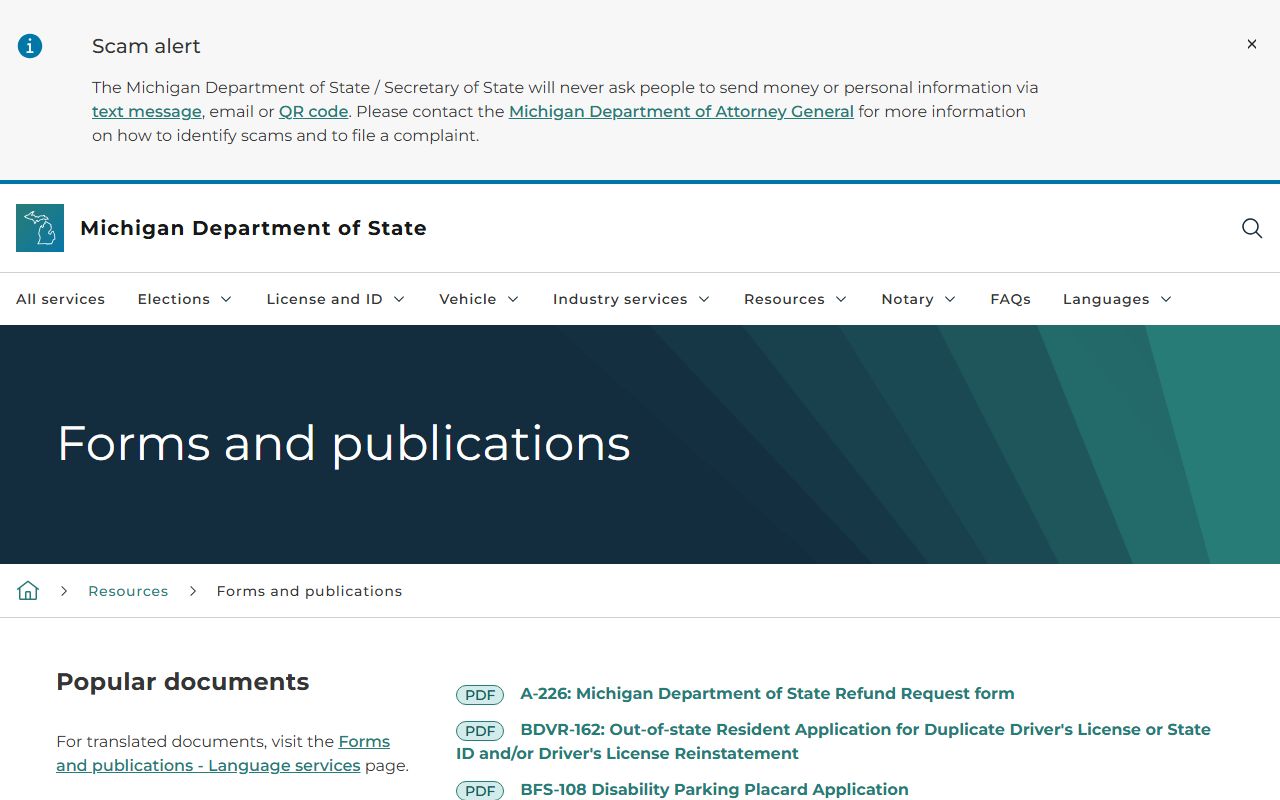
The form asks for the requester, the driver being searched, and the reason for the request. The fields below map the documented form so a driver knows what to prepare before filling it out.
| Field | Type | Required | Notes / Format |
|---|---|---|---|
| Requestor name | Text | Yes | Individual or company. |
| Requestor type | Selection | Yes | Individual or company. |
| Daytime phone | Text | Yes | Contact number. |
| Company name | Text | No | For business requests. |
| Mailing address | Text | Yes | Street, city, state, ZIP. |
| Record type / fee section | Checkbox | Yes | Lookup, certified lookup, or history request. |
| Certification / permissible purpose | Signature | Yes | Validates the request. |
| Delivery method | Checkbox | Yes | Mail same address, mail different address, or email. |
| Driver license / state ID number | Text | Conditional | Required for a driver-record request. |
| Full name | Text | Conditional | Required for a driver-record request. |
| Date of birth | Date | Conditional | Required for a driver-record request. |
| Primary reason for request | Checkbox | Yes | Employment, insurance, court, lease, or other. |
Paying or Contesting an Alcona County Traffic Ticket
The 81st District Court accepts payment in three ways. A driver can pay in person at the courthouse, mail a certified check or money order, or pay online through Government Payment Services. Card payments run by phone at (888) 604-7888, and they require the citation number plus the pay-location code, which is 1044 for this court. Personal checks are not the mail option, so use a certified check or a money order when sending payment.
Deadlines matter. An unpaid citation picks up a $25 late fee after 14 days. After 56 days from the due date, the court adds another 20 percent and the driver license is suspended. Clearing a suspended citation later costs a $45 clearance fee, so paying or contesting early is far cheaper.
Contesting works differently. A driver who wants to fight a ticket keeps the court date on the citation and appears, or asks the court for a formal or informal hearing. The steps below outline the full choice between paying and contesting.
- Read the citation and note the citation number and the due date.
- Decide whether the ticket is a civil infraction you will pay or a charge you will contest.
- To pay, choose in person, mail with a certified check or money order, or online.
- For a card payment, have the citation number and pay-location code 1044 ready.
- To contest, keep the court date or request a hearing before the deadline.
- If the problem sits on the state driving record instead of the court file, use the SOS process.
Public Access to Alcona County Traffic Records
Traffic court records are open to the public, but two different rulebooks apply. Court files sit under the Michigan court rules, not the county Freedom of Information Act. County government records that are not court files fall under the state FOIA instead. Knowing which applies tells you where to send a request and how it will be answered.
The Michigan Secretary of State also publishes guidance on how driver and vehicle records are released and redacted. The SOS driver and vehicle records FAQ explains what the state shares and what it withholds.
That FAQ is a useful stop because it draws the line between an open court record and a driver record with privacy limits. The statutes below frame the whole access picture.
Key Statutes:
Michigan Court Rule 8.119 - court records are governed by court rule, and access can be limited by statute, rule, or order.
Michigan Code § 15.243 - the FOIA exemption section that lets a public body withhold certain categories of information.
Court Traffic Records vs State Driver Records
This is the distinction that trips up most people. The county court traffic record is the case file for a single citation. The state driver record is the Secretary of State compilation of a person's driving history, points, and license status. They live in different systems, and fixing one does not automatically fix the other.
The state driving-record page lays out the fee and access options for the SOS file. The Michigan driving-record page shows online, mail, and office-visit choices along with what the record contains.
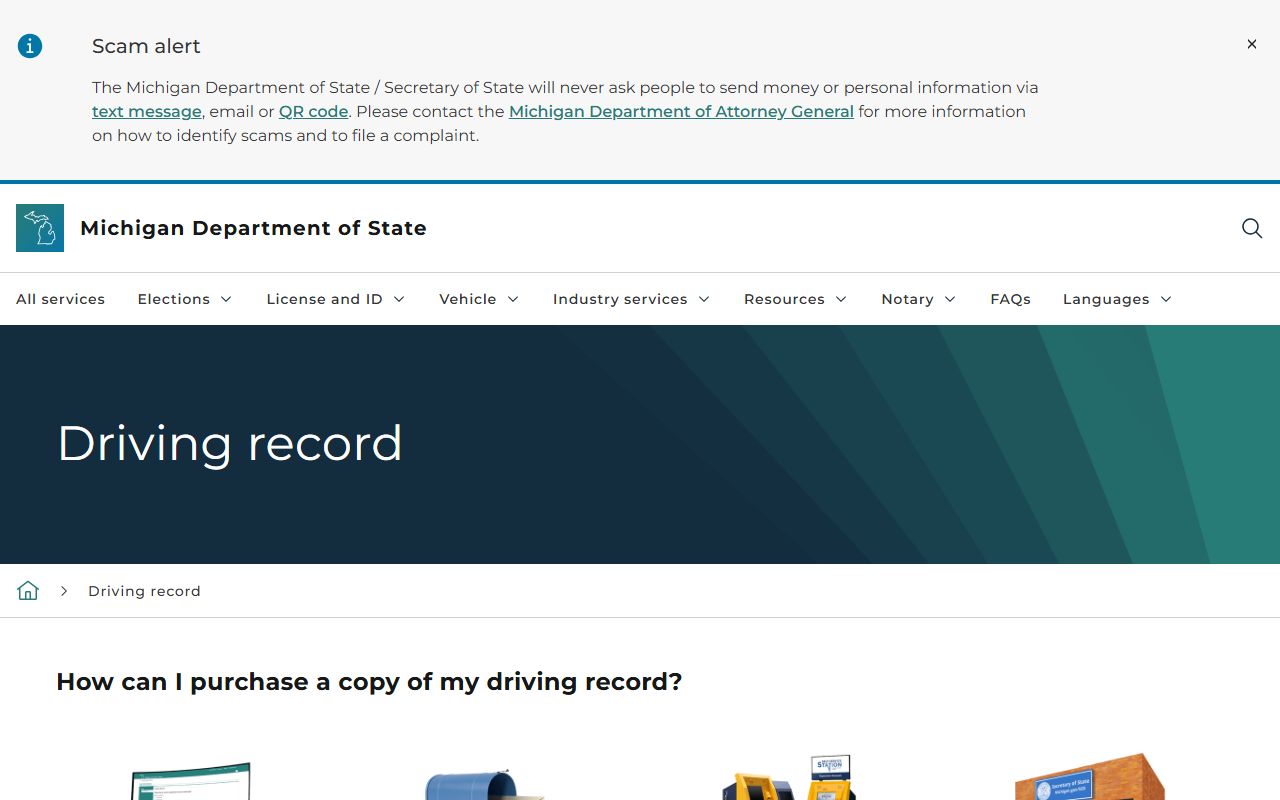
An online SOS record costs $16 and stays visible for seven days. A mailed copy is $15, and a certified copy by mail or in an office is $16. If a court entry is wrong on the driving record, the fix starts at the court, which issues a corrected abstract to the state.
| Comparison Point | Court Traffic Record | State Driver Record |
|---|---|---|
| Record source | 81st District Court case file | Michigan Secretary of State |
| What it contains | Citation, charge, court date, disposition, balance | License status, convictions, points, suspensions |
| Where to access | MiCOURT case search or the district court counter | SOS online, by mail, or at an office |
| How to correct errors | Ask the court to review and amend the case file | Court issues a corrected abstract to the state |
Note: A clean payment on the court file does not remove points already reported to the state, so check both records when a job or insurance rate depends on the answer.
CDL and Commercial Driver Records
Holders of a commercial driver license face stricter rules than other drivers. A charge that a regular driver might resolve with a quiet payment can carry mandatory reporting and harsher consequences for a CDL holder. Federal rules limit how commercial violations can be masked or deferred, so an easy dismissal is often off the table.
For that reason, CDL drivers should treat any Alcona County traffic citation as a matter worth reviewing carefully before paying. A conviction can reach the driving record and the commercial license at the same time. When the stakes touch a livelihood, confirming the charge and the plea options first is the safer path.
DUI and DWI Cases in Alcona County
Drunk-driving charges are not ordinary traffic tickets. Operating while intoxicated is a criminal matter, so it does not follow the pay-the-fine path that civil infractions use. These cases open a full criminal file with arraignment, pleas, and possible sentencing, even though they begin with a traffic stop.
For full Alcona County DUI and DWI case information, see the Alcona County criminal court records page.
Defensive Driving and Deferred Options
Some drivers ask whether a class or a deferral can keep a ticket off the record. Options depend on the charge and on what the court and prosecutor allow, and the district court cannot give legal advice about a specific case. A driver who wants to avoid points should raise the question before entering a plea, not after.
The safest move is to contact the 81st District Court directly and ask what applies to the citation at hand. Any arrangement that changes a plea or a charge is decided by the court, so the citation number and the court date are the starting point for that conversation.
Sealing or Expunging Alcona County Traffic Records
Michigan's set-aside law lets some convictions be cleared, but traffic offenses are treated differently. The county expungement guidance is blunt on this point: the offense cannot be a traffic offense to qualify for a set-aside. That limit is written into the state statute itself.
The controlling section spells out the traffic exclusion inside the set-aside act. Readers can review Michigan Code § 780.621c to see how traffic offenses fall outside the general expungement path.
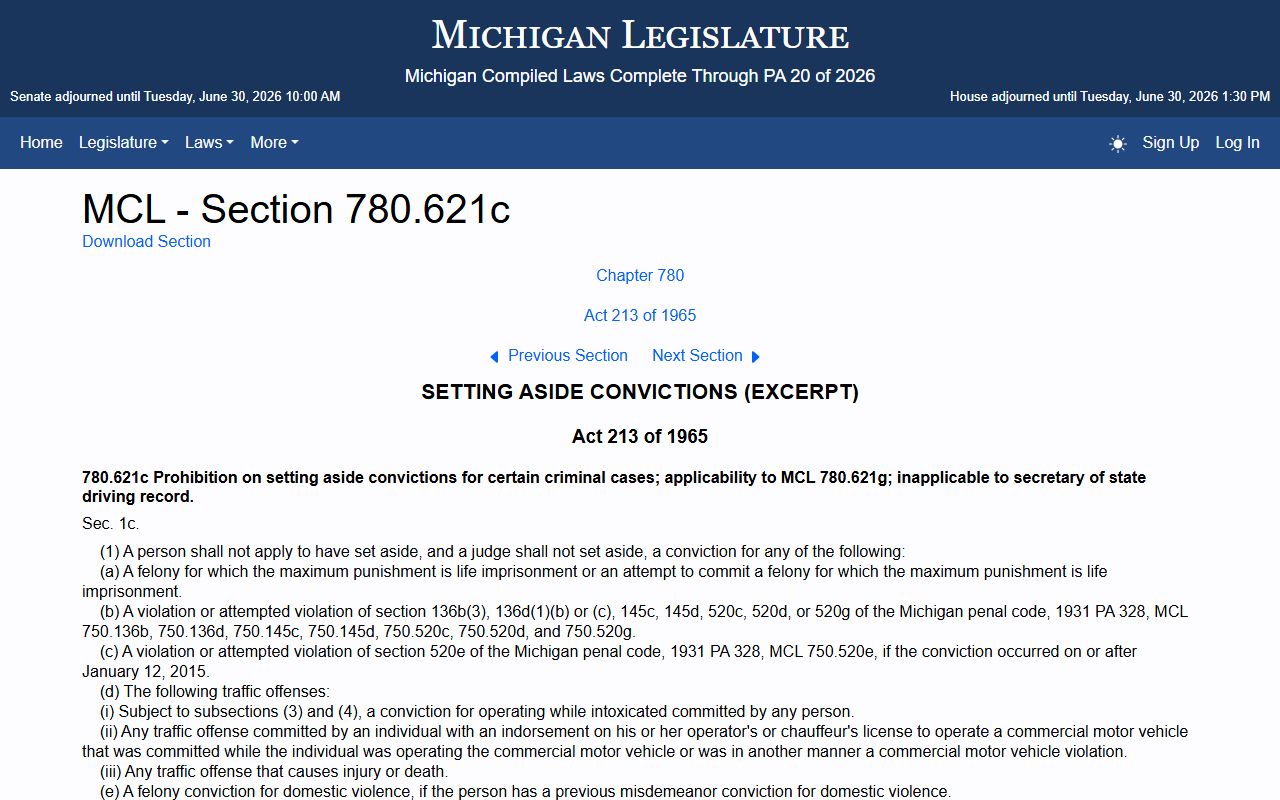
Because traffic convictions generally cannot be set aside, the practical focus shifts to handling a ticket well the first time. A dismissal, a reduced charge, or a deferral decided before conviction does far more than a later request to clear the record. The county expungement page also reminds users that the court cannot give legal advice on eligibility.
Fees for Alcona County Traffic Records
Traffic costs fall into two buckets: the fees that pile onto an unpaid citation, and the fees to obtain a driving record from the state. The court fees reward quick action, while the record fees depend on how you request a copy. Certified copies for legal use cost more than a plain lookup.
The amounts below pull the documented traffic and driving-record fees together in one place.
| Item | Amount |
|---|---|
| Citation late fee (after 14 days) | $25 |
| Additional assessment (after 56 days) | 20% of the balance |
| Citation clearance fee | $45 |
| Driving record online (SOS) | $16 |
| Driving record by mail (copy) | $15 |
| Certified driving record (mail or office) | $16 |
Note: The 56-day mark triggers both the added 20 percent and a license suspension, so a citation is far cheaper to resolve inside the first two weeks.