
Criminal Court Records in Alcona County
An Alcona County criminal court record is the case file a court clerk opens the moment charges are filed. It is a running history of one criminal case. The clerk logs every document and event, from the first complaint to the final order. In Alcona County the county clerk also serves as the circuit court clerk, so felony files run through that office. The district court keeps its own criminal file for lower offenses. The record is built by the court, not by the police. That is why a criminal court record can differ from an arrest report or a jail booking sheet.
Which Alcona County court holds the file depends on the charge. The district court handles misdemeanors, the early stages of felony cases, and preliminary hearings. The circuit court takes felony cases for trial and sentencing, along with serious misdemeanors sent up from below. A single case can start in one court and finish in another. A felony often opens at the district level, then moves up once a judge binds it over. The charges themselves get a closer look on the Alcona County arrest records and court charges page.
Search Alcona County Criminal Court Records
Alcona County has no separate local criminal records portal. Public case lookups run through the statewide MiCOURT case search, which the Michigan courts keep for every county. It covers criminal, traffic, civil, family, and probate matters in one place. A searcher can begin from a name or a case number.
- Open the statewide MiCOURT case search and pick the criminal case type.
- Search by the defendant's last and first name, or by the exact case number.
- Narrow the results by court, case year, or hearing date when the list runs long.
- Open the matching case to read the docket, the charges, and the disposition.
- Ask the county clerk for a certified copy when a record is needed for legal use.
State-level tools fill the gaps the case portal leaves. The Michigan Department of Corrections runs the Offender Tracking Information System (OTIS) for people in prison, on parole, on probation, or discharged within the last three years. It is not a county jail roster. The public court-display page for the Alcona County Trial Court shows upcoming hearings by party name, time, case number, and CTN. For older or paper-only files, the clerk counter stays the surest path.
Stages of an Alcona County Criminal Case
An Alcona County criminal case moves through set steps, and each step leaves a mark in the record. The file grows as the case advances. Early entries log the charge and the first appearance. Later entries capture motions, hearings, and the outcome. Reading the docket in order shows how the case unfolded, from the accusation to the sentence.
Charges start with the county prosecuting attorney's office, led by Elizabeth Reed as the county's chief law-enforcement officer.
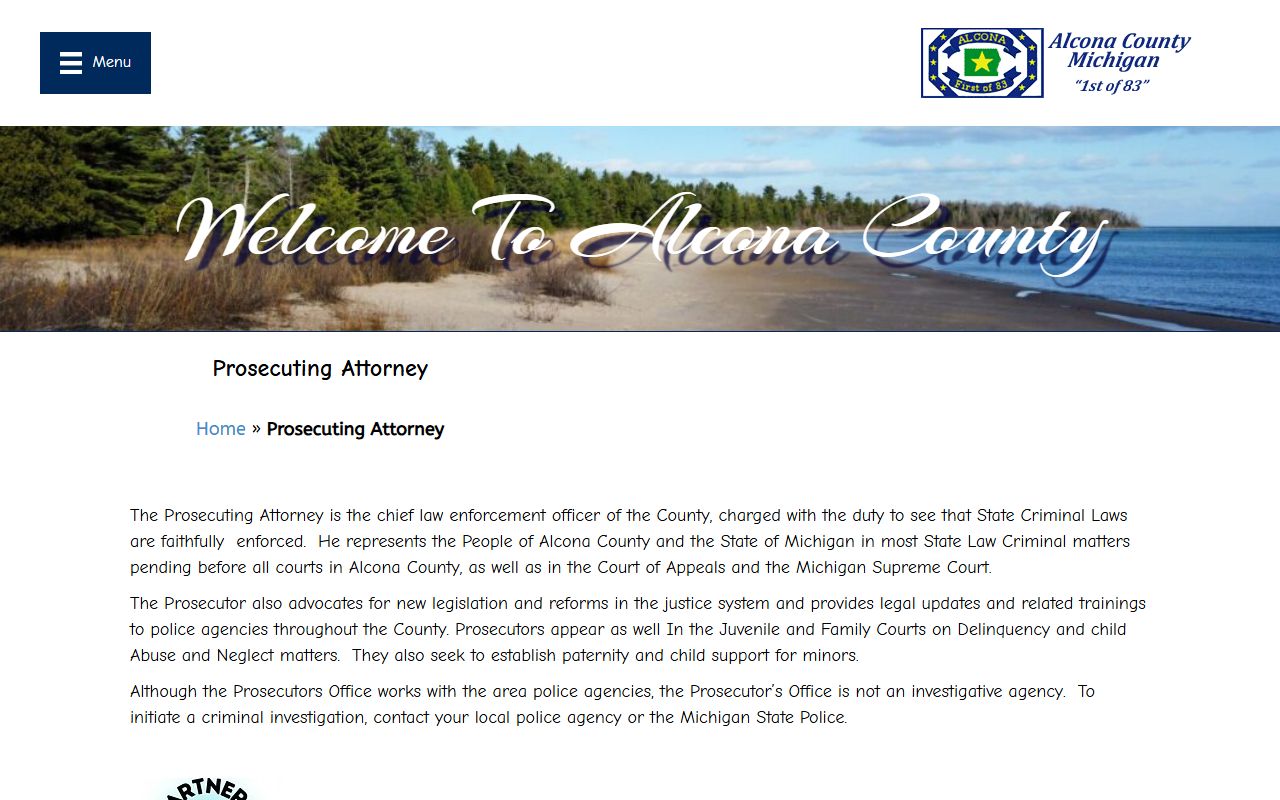
The prosecutor decides what to file after an arrest, and that choice sets the case type, the court level, and the penalties in play. An assistant prosecutor and a victims-rights contact round out the small office. Once the charge is filed, the case enters the stages below.
Case flow: Charges Filed › Arraignment › Pretrial / Motions › Plea or Trial › Disposition › Sentencing
| Stage | What Happens |
|---|---|
| Arraignment | The court reads the charge, sets bond, and takes a first plea. This is the earliest hearing logged in the file. |
| Pretrial / Motions | Both sides exchange evidence and file motions. A felony may pass through a probable-cause conference and preliminary exam before it is bound over. |
| Plea or Trial | The defendant pleads guilty or no contest, or the case goes to trial for a verdict by judge or jury. |
| Sentencing | After a conviction the court imposes jail, prison, probation, fines, or restitution, and records the terms. |
What Alcona County Criminal Records Show
A criminal court file is more than a single sheet. It gathers the charge, the parties, the events, and the result in one docket. Alcona County case records share a fairly steady set of fields across the local courts. The table maps the core parts a reader will meet when opening a case. Some entries stay brief on a public display, while the full paper file holds every motion and order.
| Field | What It Shows |
|---|---|
| Case Number | The unique code the clerk assigns, often with a letter marker such as CR or FH for felony tracking. |
| Defendant | The person charged, listed by name, with a case-tracking number tying the file to state systems. |
| Charges | Each count as filed, with the statute cited and the offense level noted as a felony or misdemeanor. |
| Plea | The response entered: guilty, not guilty, or no contest, with any later change recorded. |
| Disposition | How the case ended, such as a conviction, a dismissal, a diversion, or an acquittal. |
| Sentence | The penalty imposed, including jail or prison time, probation, fines, costs, and restitution. |
Charges vs. Convictions
Being charged is not the same as being convicted. An Alcona County criminal court record can list charges that were later dropped, dismissed, or ended in acquittal. A charge is only an accusation. A conviction is a finding of guilt through a plea or a verdict. Reading a file well means checking the disposition, not just the opening count. Many cases end in a lesser charge than the one first filed.
| Charge | Conviction | |
|---|---|---|
| Stage | Accusation | Verdict or plea |
| Burden of Proof | Probable cause | Beyond reasonable doubt |
| Public Record | Yes | Yes |
Reading Dispositions and Sentences
The disposition line tells you how a case closed. A few short codes carry a lot of weight. Guilty and not guilty are the plain outcomes. No contest, sometimes written as nolo, accepts the penalty without admitting the facts. Dismissed means the charge ended without a conviction. Deferred means judgment is held back while the defendant meets set terms, and the charge may drop if those terms are met.
- Guilty: a plea or verdict that results in a conviction.
- Not guilty: an acquittal after trial, with no conviction entered.
- Dismissed: the charge is closed without a finding of guilt.
- No contest: the penalty is accepted without an admission.
- Deferred: judgment waits while conditions are met.
The sentence follows a conviction. Read it for the top line first: prison, jail, probation, or a fine. Then check for added terms such as costs, restitution to a victim, community service, or treatment. Probation puts a person under supervision in the community, while parole is supervised release from prison. The record notes the length of each term and any later violation.
Sealed vs. Expunged Records
Sealed and expunged records are not the same thing. A sealed record still exists but is hidden from general public view. An expunged, or set-aside, record is treated as though the conviction never happened. Michigan handles this through its conviction set-aside statute, which gives eligible people a path to clear qualifying convictions. Eligibility turns on the offense type and the time that has passed.
| Sealed | Expunged | |
|---|---|---|
| Visibility | Hidden from public | Destroyed / treated as never existed |
| Law Enforcement | Limited access | Very limited |
| Eligibility | By court rule or order, MCR 8.119 | Set-aside under MCL 780.621, after the waiting period |
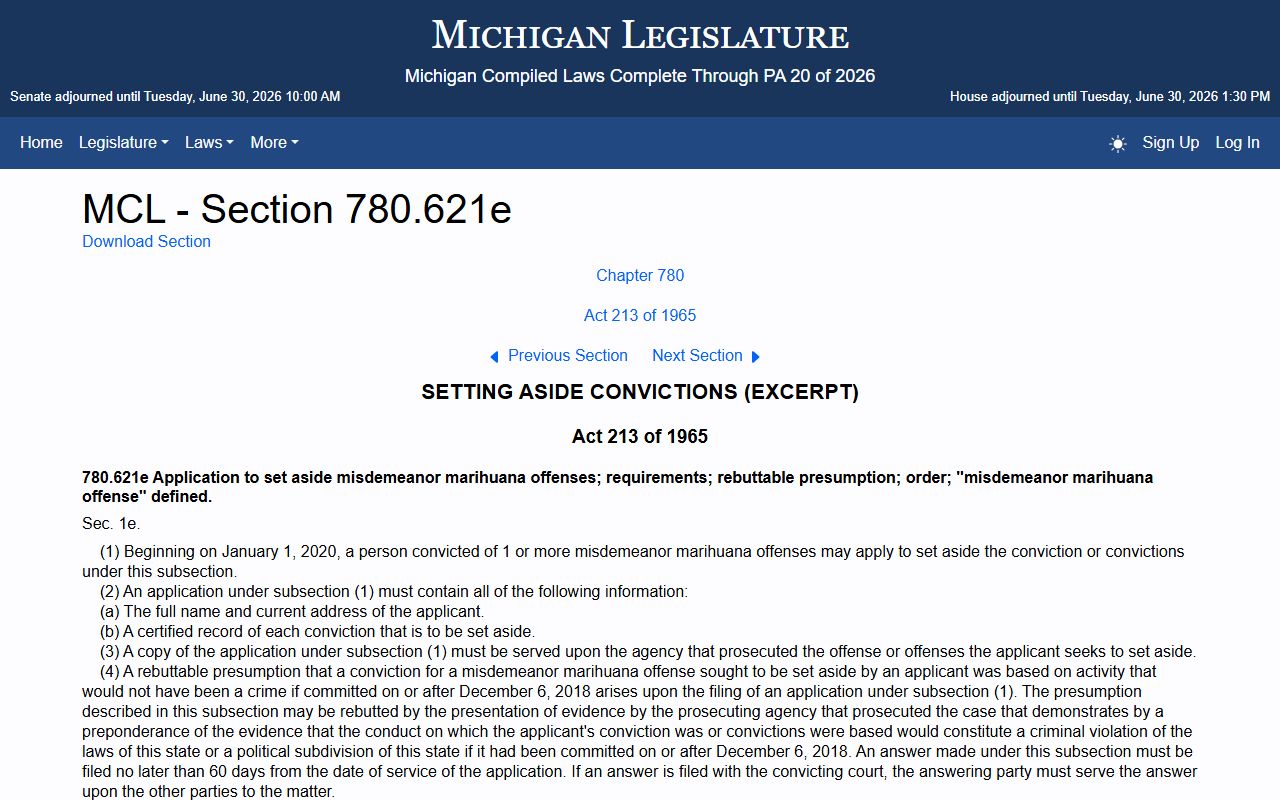
Michigan has widened set-aside relief in recent years, including a rule for certain marijuana misdemeanors. That change is set out in the state's misdemeanor marijuana set-aside section, which lets people petition to clear those specific convictions.
The local district court lays out the practical steps. Misdemeanor set-asides are filed at the district court, while felonies go to the circuit court. At least five years must pass since the sentence, and traffic offenses do not qualify. The process runs about 60 to 90 days, the applicant must appear at the hearing, a record-check fee near fifteen dollars starts it, and fingerprints cost roughly fifty dollars through the Michigan State Police.
Note: The court cannot give legal advice, so anyone unsure about eligibility should speak with an attorney before filing a set-aside petition.
Public Access to Alcona County Criminal Records
Most adult criminal court files in Alcona County are open to the public. Two systems govern that access. The Michigan Freedom of Information Act treats government records as presumptively open unless an exemption applies. Court files, though, follow a separate court rule rather than the county request form. Together these rules keep dockets, charges, and dispositions available while still shielding sensitive material. The broader set of filings sits with all court records kept by the clerk.
Set-aside relief can later remove an eligible conviction from public view, and Michigan has built an automatic route for some records. The state's automatic set-aside section spells out how that clearing is carried out without a petition.
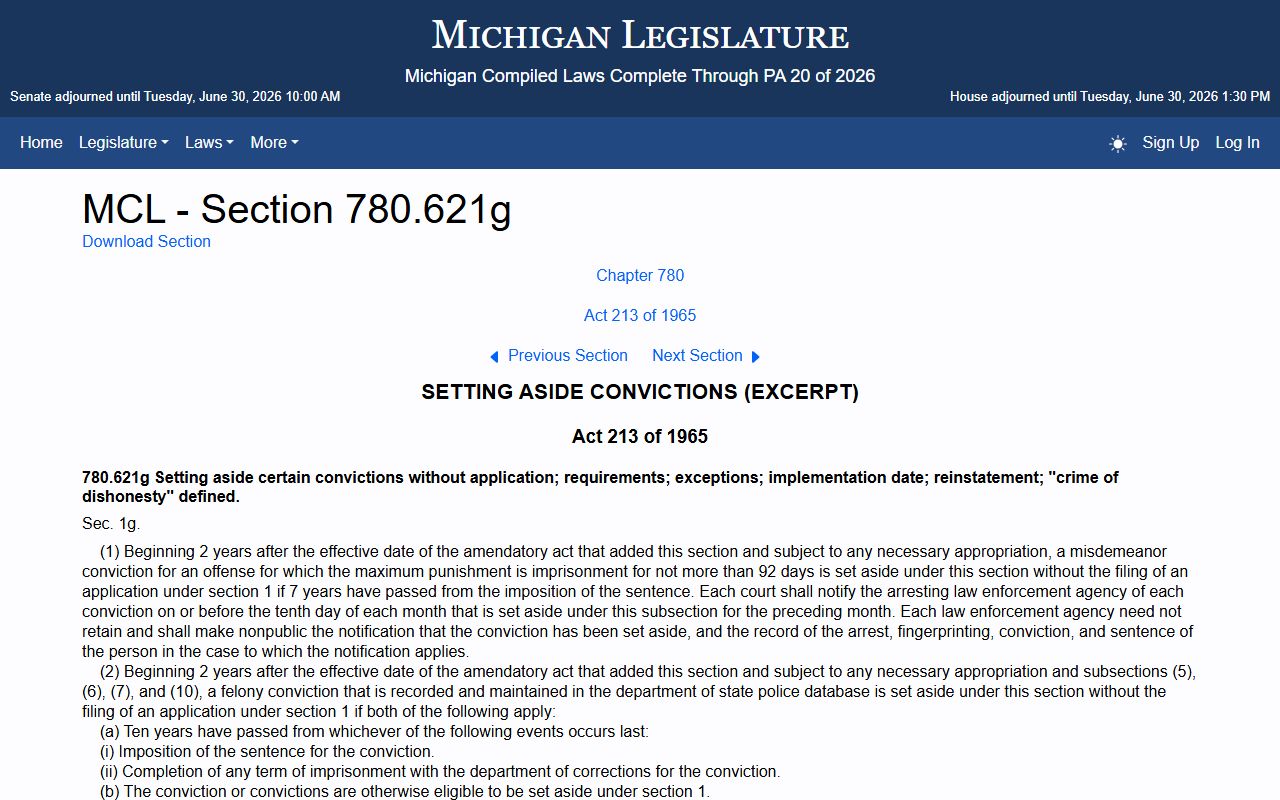
Even with automatic clearing, most active files stay open while a case is pending. Access can still be limited by statute, by rule, or by a specific court order.
Key Statutes:
Michigan Code § 15.231 - the Freedom of Information Act policy section, which makes public records presumptively open.
Michigan Code § 15.243 - the FOIA exemption section, which lets a public body withhold certain protected categories.
Michigan Court Rule 8.119 - the rule that governs court case records and how access can be limited.
Background Check Considerations
A casual case lookup and a formal background check are not the same. Looking up one case on a public portal is quick and free. A background check for a job, a lease, or a license must follow the federal Fair Credit Reporting Act and pull from vetted sources. Court dockets can lag, carry data-entry errors, or miss a sealed outcome. For a decision with legal weight, a certified copy from the county clerk is the reliable source.
Important: This site is not a consumer reporting agency under the Fair Credit Reporting Act, and its records may not be used for employment, tenant, or credit screening.
Restricted Criminal Court Records in Alcona County
Some criminal court records are closed or narrowed by law. Juvenile files are far more restricted than adult cases, and child-protection matters are shielded under Michigan's confidentiality statute. Adoption records are closed by default, with inspection controlled by the court under the adoption inspection statute. Mental-health proceedings and sealed convictions also sit outside general public access.
A set-aside is not always final, either. A prosecutor or a victim can object, and the state provides a route to reinstate a conviction in some cases, laid out in the set-aside reinstatement section.
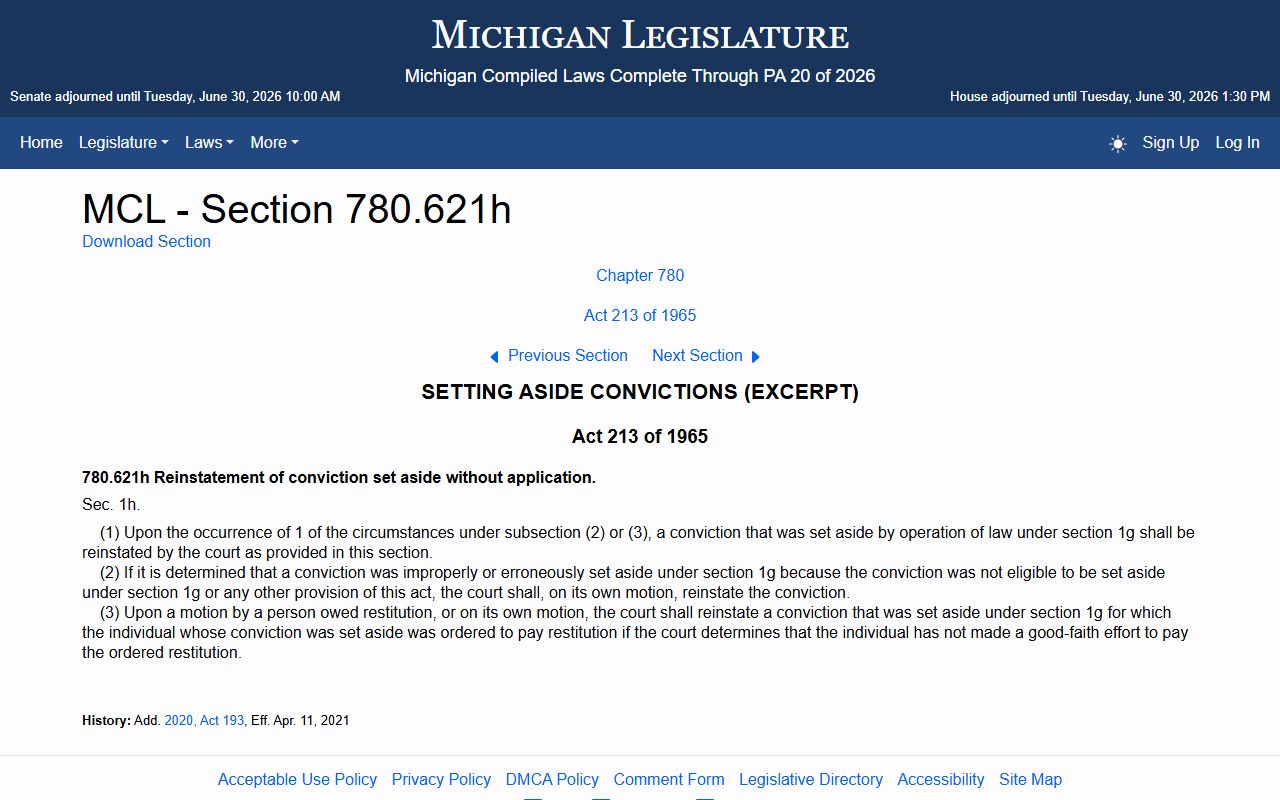
That reinstatement path shows why a cleared record is still tracked behind the scenes even when the public view is limited. A set-aside filing also needs fingerprints, which the Alcona County Sheriff's fingerprinting service can take for the record-check step.
Fingerprints let the Michigan State Police confirm a person's record before the court rules on a petition. Personal identifiers such as Social Security numbers are redacted from public copies as a matter of course. When a file is not visible online, the clerk counter can confirm whether it is sealed, restricted, or simply not yet digitized.