
Alcona County Arrest Records and Charges
An Alcona County arrest record documents the arrest event itself. It can show who made the arrest, the arresting agency, the date, and the booking that follows. In this county, the Sheriff's Office and local police handle that booking side. An arrest, though, is only a claim of custody. The prosecutor decides what happens next. Elizabeth Reed, the county Prosecuting Attorney, reviews the police report and files the formal charges with the court clerk. At that point the charges become the court charge record. The arrest record and the charge record answer two different questions. One asks who was taken in. The other asks what the state formally alleges.
Keeping the two records apart saves a lot of confusion. The arrest and booking detail sits on the custody side, held by the sheriff and the jail. For the jail roster and booking information, the Alcona County inmate records page is the better starting point. The court charge record is what the prosecutor filed and how each charge moves through the case. It lists the counts, the statute behind each one, and the current status of the court charges after arrest. The full case file, with pleas, hearings, verdict, and sentence, lives with the criminal court records. Arrest records open the story, and the charge record and case file finish it.
Find Alcona County Arrest Records
There is no separate Alcona County arrest-records portal. Charge information shows up through the statewide MiCOURT case search, which covers the county's trial courts. The public hearing display for the Alcona County Trial Court lists party name, hearing time, hearing information, case number, and the case-tracking number. To read the actual charges, open the case and review the charge list. Arrest and booking detail does not appear here. That stays on the custody side with the sheriff and jail.
- Open the MiCOURT case search or the public court display.
- Search by the defendant's name or by the case number.
- Open the matching case and read the full charge list.
- Check each charge's code, level, and current status.
The Sheriff's Office also runs services that touch the arrest side of the record. The Alcona County Sheriff's Office corrections page explains how booking and jail lodging work in a small, limited-staff county.
That corrections context matters because many Alcona arrests route straight to a neighboring county jail, which affects where the booking record actually sits. For the charges themselves, though, the MiCOURT case search is the single online path that pulls the county's filings into one place.
Note: A hearing display shows scheduling data, so open the full case record when you need the exact charges and their status.
How Charges Get Filed After Arrest
Walk the process forward from the arrest. Booking happens first on the custody side. The charge record then begins when the prosecutor files a charging document with the court. That document names each count and points to the statute behind it. Michigan uses three main charging documents, and the one used depends on the offense level and the court.
| Complaint | Information | Indictment | |
|---|---|---|---|
| Filed By | Officer / Prosecutor | Prosecutor | Grand Jury |
| Common For | Misdemeanors | Many felonies | Serious felonies |
| Starts | The case | The case | The case |
Most Alcona County cases start with a complaint. District court handles misdemeanors and the early felony steps, including the preliminary examination. When a felony is bound over, the prosecutor files an information in the circuit court. Grand jury indictments are rare in this part of Michigan, so most readers will see a complaint or an information rather than an indictment.
Alcona County Charge Status Terms
Charges do not stay frozen once they are filed. As a case moves, a charge can be amended, reduced, added, dropped, or dismissed. The status field tells you where a count stands right now. A few plain terms cover most of what shows up in the record.
| Status | What It Means |
|---|---|
| Pending | The charge is filed and active, with no plea, verdict, or dismissal yet. |
| Amended / Reduced | The prosecutor changed the charge, often to a lower level or a different statute. |
| Dismissed | The court dropped the charge, sometimes with prejudice and sometimes without. |
| Nolle Prosequi | The prosecutor formally chose not to pursue the charge any further. |
Read every count on its own. One case can hold several charges, and each can carry a different status. A charge marked dismissed without prejudice can be refiled later, while one dismissed with prejudice cannot. When the status is unclear, the county clerk or the court counter can confirm the current entry.
Note: Status labels can change between hearings, so the safest reading is the most recent docket entry, not an older printout.
Charges vs. Convictions
Being charged is not the same as being convicted. A charge is an accusation. A conviction is a plea or a verdict that settles the case. A person can be arrested, charged, and later cleared, and the record should show that outcome. Reading the two apart keeps you from treating an open accusation as a proven result.
| Charge | Conviction | |
|---|---|---|
| Stage | Accusation | Verdict or plea |
| Burden of Proof | Probable cause | Beyond reasonable doubt |
| Public Record | Yes | Yes |
Both a charge and a conviction can appear in the public record, so seeing a charge listed tells you only that the case was filed. To learn how it ended, follow the case to its disposition, where a dismissal, an acquittal, or a conviction and sentence will be recorded.
Sealed vs. Expunged Records
Some charge records are pulled from public view. Michigan handles this in two ways that people often mix up. A sealed record is hidden by court rule or by a judge's order, but it still exists. An expunged, or set-aside, record is treated as though the conviction never happened. The difference controls who can still see the file and under what limits.
| Sealed | Expunged | |
|---|---|---|
| Visibility | Hidden from public | Destroyed / treated as never existed |
| Law Enforcement | Limited access | Very limited |
| Eligibility | Set by court rule or judge's order under MCR 8.119 | Eligible convictions after the waiting period under MCL 780.621 |
Michigan's set-aside law carries real limits. An eligible conviction usually needs at least five years since the sentence, the offense cannot be a traffic offense, and certain serious crimes are excluded. Misdemeanor set-asides run through district court and felony set-asides through circuit court. Once granted, access to the file becomes much narrower.
Alcona County Charge Codes
Every charge ties back to a statute, and that link is the charge code. The code tells you which law was allegedly broken and how serious the offense is. Michigan sorts offenses into felonies, misdemeanors, and civil infractions. Felonies carry the heaviest exposure, misdemeanors are lower-level crimes, and civil infractions are lighter matters such as most traffic tickets. One arrest can produce several separate charges, each with its own code and level.
The Sheriff's Office also lists related services that feed the record, such as fingerprinting and drug or alcohol testing. The Alcona County Sheriff's Office services page describes those functions in plain terms.
Those support services matter because fingerprints and identity records help tie a charge to the right person and the right statute. In the court file, Michigan uses short markers to sort case types, such as CR for criminal felony tracking and CV for civil, which helps you spot the level of a charge at a glance.
Statewide Charge and History Lookups
Charges filed in Alcona County do not stay only in the county file. They roll up into a statewide criminal history held by the Michigan State Police. For the public, one free statewide tool sits right in the open. The Michigan Public Sex Offender Registry lets anyone search by name and view registrant profiles across the state, including people connected to Alcona County.
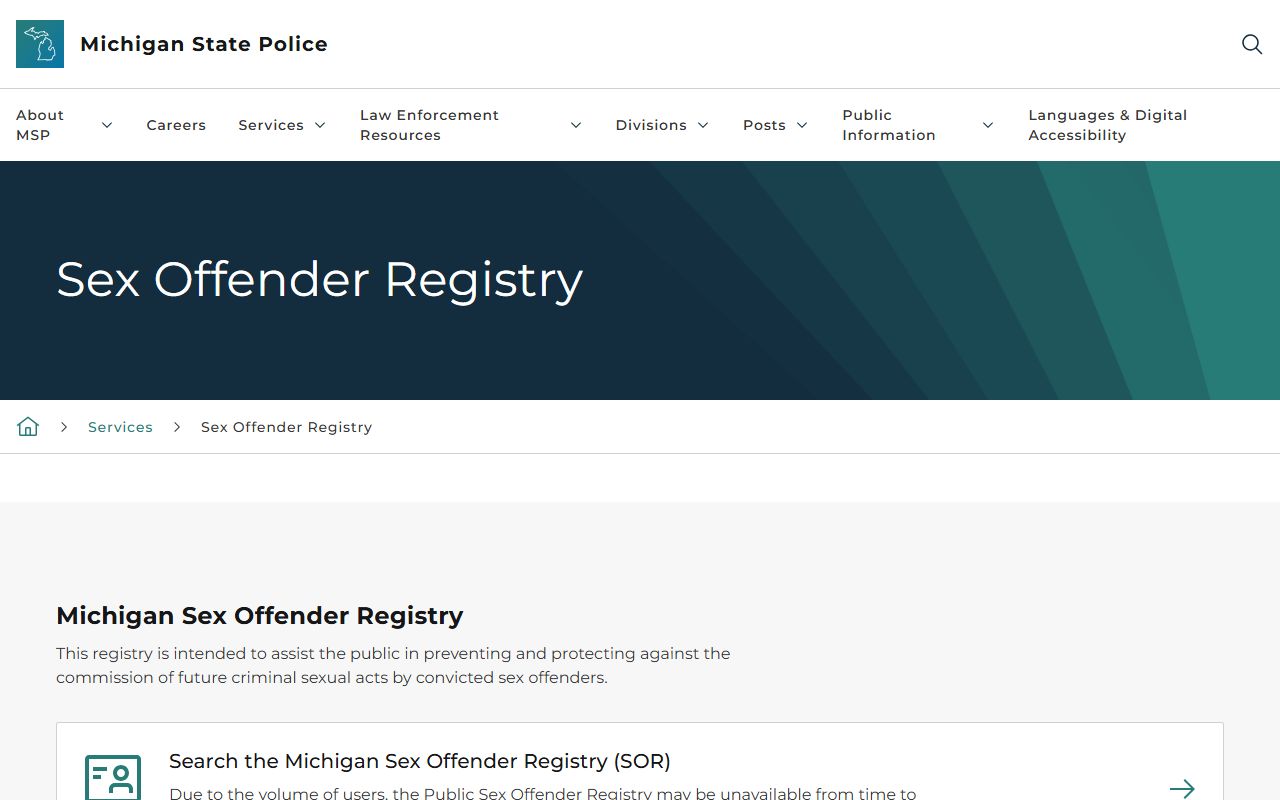
The registry is one slice of the statewide picture. A fuller criminal history record is held by the Michigan State Police and is available through its own record-check channels. For court charges specifically, the MiCOURT case search remains the direct route into the filings, while the state registry and criminal history checks add the broader statewide context.
Note: A statewide registry covers one category of offense, so it should be read alongside the court file, not as a full charge history on its own.
Alcona County Background Checks
A casual name lookup and a formal background check are not the same thing. A quick search can flag a charge, but it may miss updates, corrections, or a final disposition. A regulated background check under the Fair Credit Reporting Act follows strict rules for accuracy and for how the report can be used in hiring, housing, and credit decisions. If a charge record will drive a real decision, the formal, verified route is the right one.
The Sheriff's Office also runs fingerprinting for concealed pistol licenses and certain jobs, which is a common first step for a formal check. The Alcona County Sheriff's Office fingerprinting details spell out how that service works locally.
Fingerprint-based checks are more reliable because they match a person to a record by biometrics rather than by name alone, which cuts down on mistaken matches.
Important: This site is not a consumer reporting agency under the FCRA, and its information may not be used for employment, tenant, credit, or insurance screening.
Restricted Charge Records in Alcona County
Not every charge record is open to the public. Juvenile charges are far more restricted than adult cases under Michigan law. Sealed and set-aside convictions drop out of ordinary public view. Some dismissed matters are withheld, and details tied to an ongoing investigation may be held back until the case is resolved. These limits protect privacy and the fairness of a pending case.
The county's booking and custody records follow their own limits too. The Alcona County Sheriff's Office corrections detail shows how the jail handles lodging and transport in a limited-staff county.
Court records themselves are governed by court rule, not by the county open-records form. The state's trial court records-management guidance points to MCR 8.119, which sets how case records are kept and when access can be limited by statute, rule, or order. When a record is restricted, the clerk cannot override that rule, so the right step is to ask the court what access is allowed.