
Alcona County District Court Scope
Michigan runs its trial courts in three tracks. Circuit court is the big general court. District court is the lower court, and probate court is a separate track for estates and guardianships. In Alcona County the local district court is the 81st District Court, a single court rather than a set of numbered branches. It shares the county courthouse at 106 5th St. in Harrisville with the clerk, the circuit court, and the probate court.
The 81st District Court handles a wide slice of everyday legal life. Its docket covers traffic and ordinance violations, landlord and tenant disputes, misdemeanor criminal cases, preliminary hearings for felony cases, small claims, and civil cases up to $25,000. The court also holds weddings. Reaching the court by phone is simple: the district court line is (989) 724-9500.
Because one court holds all of these roles, the same clerks often handle both the ticket you paid last week and the small claim your neighbor filed. That shared footprint makes the office easy to navigate once you know which counter you need.
District Court Judge and Staff
The bench and the front counter are small, so the same names come up often. Hon. Laura A. Frawley serves by assignment as the 81st District Court Judge. She also sits as the Presiding Family Court Judge and as the Drug Court Judge, which means one judge touches district, family, and treatment-court work in this county. Court Administrator Jennifer Lueck runs day-to-day operations.
Two magistrate-level staff split the clerk work by case type. Courtney Bachelor is the Magistrate and District Court Criminal Clerk. Devin Jagelewski is the Deputy Magistrate and District Court Civil Clerk. A magistrate can handle certain hearings, set some bonds, and process specific filings without the judge. Brian Brink serves as the District Court Probation Officer and the Recovery Court Screening Coordinator, so he is the contact for probation and treatment-court intake.
Details for the full court roster, jurisdiction, and forms notice appear on the county's 81st District Court page and its staff directory. The contact card below gathers the core details in one place.
81st District Court
106 5th St.
Harrisville, MI 48740
Phone: (989) 724-9500
Hours: Monday to Friday, 8:30 a.m. to 4:30 p.m. (closed noon to 1 p.m.)
Judge: Hon. Laura A. Frawley (by assignment)
Court Administrator: Jennifer Lueck
District Court vs. Circuit Court vs. Probate Court
People often file in the wrong court because the three trial courts sound alike. The split is really about case size and case type. District court takes the smaller and earlier matters. Circuit court takes felonies, family cases, and larger civil claims. Probate court takes estates, guardianships, and mental-health commitments. All three sit in the same Harrisville courthouse, but each keeps its own files and its own clerk.
The table lines up the three courts by what each hears, the dollar limits that steer civil cases, and where an appeal goes next. The 23rd Circuit Court covers Alcona, Arenac, Iosco, and Oscoda Counties and has three judges. The county clerk doubles as the circuit court clerk for the Alcona division.
| District Court | Circuit Court | Probate Court | |
|---|---|---|---|
| What It Handles | Traffic, ordinance, misdemeanors, felony prelims, small claims, landlord-tenant, weddings | Felonies, serious misdemeanors, domestic relations, child protection, delinquency | Estates, wills, guardianships, conservatorships, name changes, mental-health cases |
| Civil Dollar Limit | Up to $25,000 | Over $25,000 | Small-estate assignment under $20,000 |
| Appeals Go To | Circuit Court | Michigan Court of Appeals | Michigan Court of Appeals |
Note: A specialty program like Recovery Court does not replace the court that owns the case; the underlying charge still sits with district or circuit court.
How a Case Moves Through the System
Cases climb one rung at a time. A matter that starts in the 81st District Court does not jump straight to the state's top bench. If a party disagrees with a district court ruling, the first appeal goes to circuit court. From circuit court, the next stop is the Michigan Court of Appeals, the state's middle appellate court. The Michigan Supreme Court sits at the top and hears only a limited set of cases it agrees to review.
The flow below shows the ladder for a district court case in plain order.
Appeal path: 81st District Court › 23rd Circuit Court › Michigan Court of Appeals › Michigan Supreme Court
Felony cases follow a related but separate track inside the trial level. A felony charge starts with a preliminary hearing in district court. If the judge finds enough proof, the case is bound over to circuit court for trial and sentencing. So a serious case can pass through district court on its way up even before any appeal is filed.
Security Rules Before You Come to Court
Arriving prepared matters more than most people expect. The 81st District Court screens everyone who walks in. Both your person and your belongings are subject to search, and prohibited items are seized at the door. Treat the visit less like a quick library stop and more like a secured building entry. Bring only what you need for your hearing.
The court also enforces a dress code. Shorts, skorts, sleeveless shirts, tank tops, cut-offs, hats, and caps are not allowed. Shoes are required. Inside the courtroom, food, drinks, chewing gum, and smoking are banned. Young children are not allowed in the probation office or the courtrooms during sessions without prior permission.
One more point is easy to miss. The 81st District Court is a court of record, which means proceedings are recorded. The county lists these rules on its before you come to court page. A parking map, ADA entrance map, and transit schedule were not published in the reviewed county sources.
Forms and Self-Help Resources
Most district court filings run on standard statewide forms. Michigan uses SCAO forms, produced by the State Court Administrative Office, so a small-claims affidavit or a civil summons looks the same in Harrisville as it does across the state. Using the correct form up front avoids a rejected filing and a second trip to the counter.
The county gathers its filing tools in one spot. A quick look at the court's resource hub shows how the self-help links are organized.
The court's resources and forms page lists the SCAO forms and self-help materials residents reach for most.
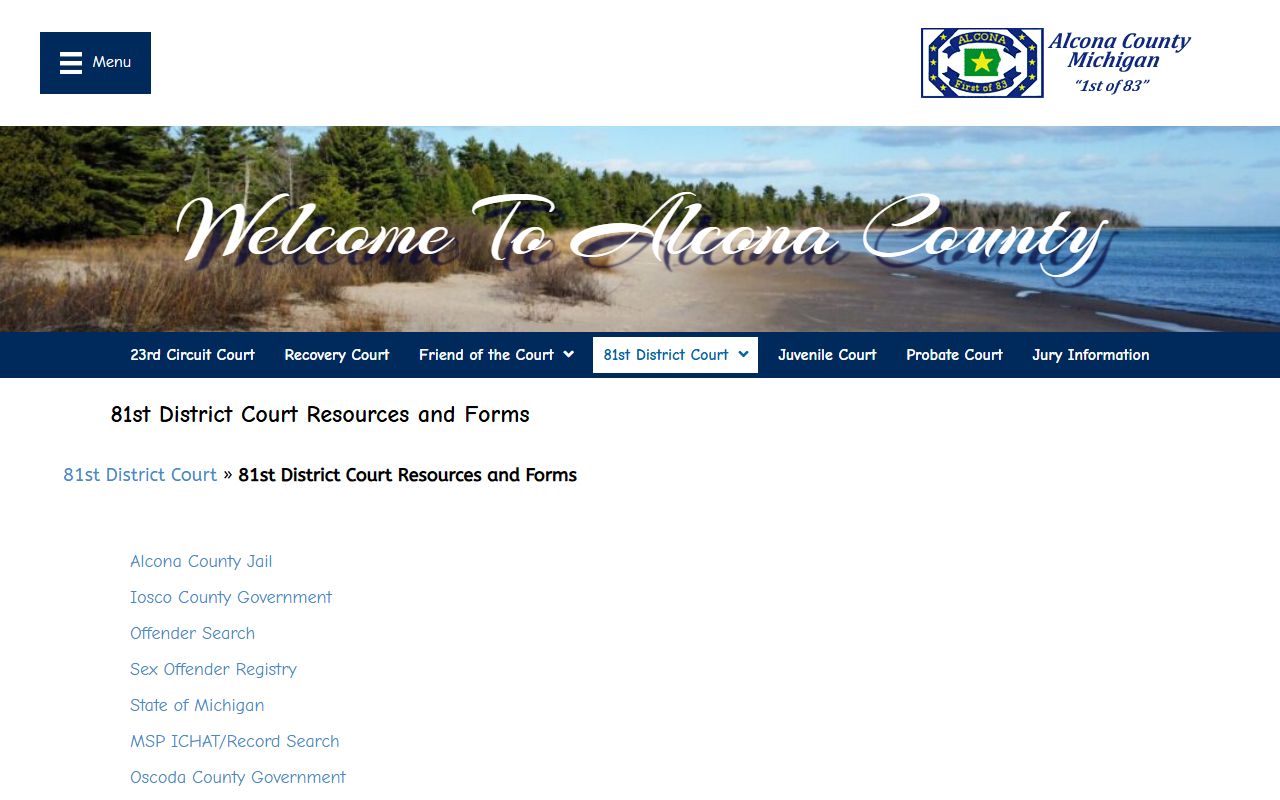
That page routes people to the right packet without needing legal advice from staff. The court cannot fill out forms for you or tell you what to file, so the self-help library carries a lot of weight. When a case is older or not online, the clerk counter and a formal records request remain the fallback. Michigan court records are governed by court rule MCR 8.119, not by the county's FOIA form.
Traffic and Small Claims Cases
Traffic tickets are the highest-volume matter the district court sees. Citations can be paid in person, by mail, or online. Mailed payments must be a certified check or money order. Online card payments run through Government Payment Services at (888) 604-7888, and the Alcona County District Court pay-location code is 1044. Keep the citation number and that code handy.
The county traffic page spells out the deadlines and penalties drivers most need to watch.
The court's traffic page lays out the payment options and the late-fee clock in one place.
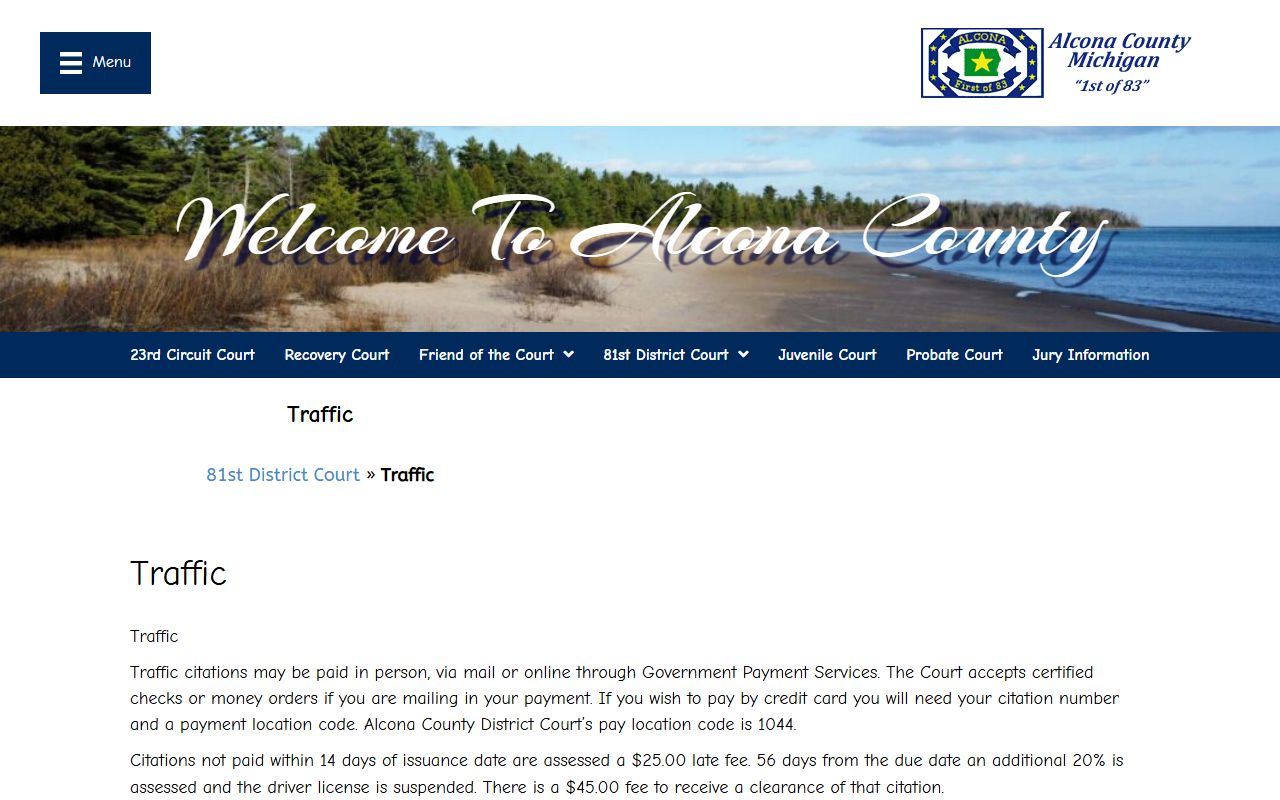
The penalties add up fast. An unpaid citation picks up a $25 late fee after 14 days. After 56 days from the due date, another 20% is added and the driver's license is suspended. Clearing a citation later costs a $45 fee. The court traffic file is not the same record as the state driver record kept by the Secretary of State; one is the citation and disposition, the other is the statewide driving history.
Small claims is the court's other high-traffic civil track. It is built for people to settle money disputes without a lawyer, and the district court handles claims within its civil limit. Filing venue, the fee schedule, and settlement rules are set out on the county's small claims page.
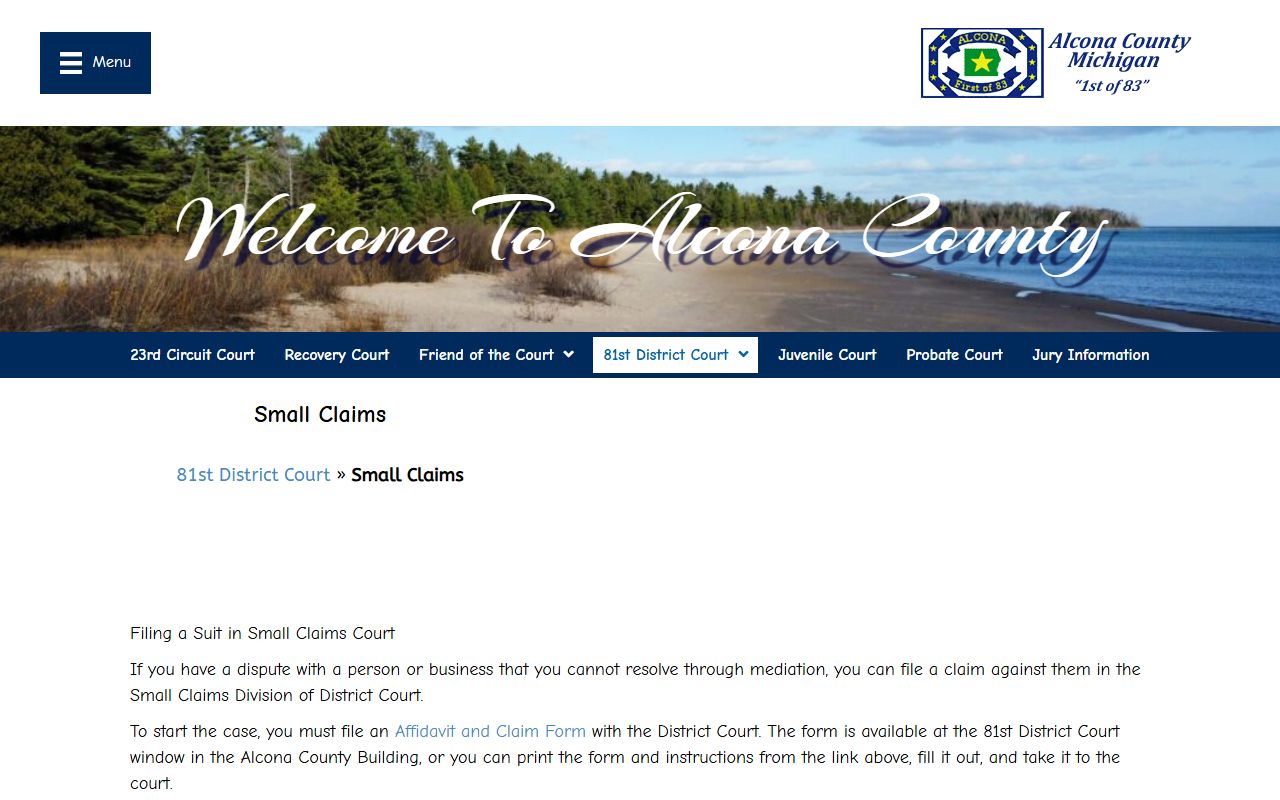
A small-claims judgment is a real court order, and the case file lists the parties, the amount, and the outcome. Broader case searching and docket details live in the Alcona County court records for anyone tracking a filing across court levels.
Criminal Misdemeanors and Preliminary Hearings
On the criminal side, the district court owns misdemeanors and the opening stage of felonies. A misdemeanor is a lower-level crime that carries up to a limited jail term, and the district court can take it from first appearance through sentencing. That covers many of the county's criminal filings from start to finish.
Felonies work differently. The district court holds the preliminary hearing, sometimes called a probable-cause hearing, where the judge decides whether there is enough proof to send the case forward. If there is, the case is bound over to the 23rd Circuit Court, which handles the trial and any prison sentence. So the district court is the gate a felony passes through, not its final stop.
Case clearing follows the same divide. District court reviews set-aside requests for misdemeanor convictions, while felony set-aside procedures run through circuit court under a separate part of the statute.
The felony and serious-misdemeanor set-aside procedures appear in MCL 780.621d, part of Michigan's conviction set-aside act.
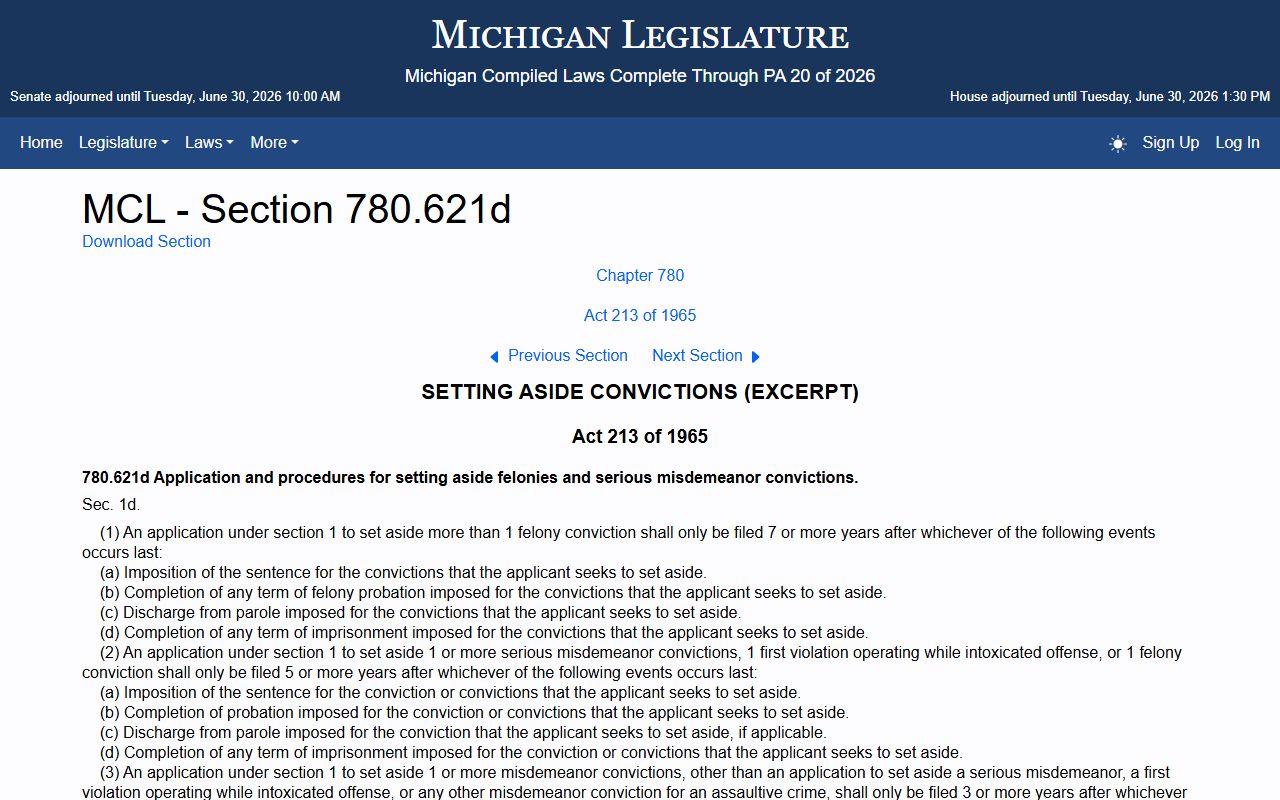
Reading that statute helps a person understand which court to petition before spending money on prints or record checks. Full charge and disposition detail for a criminal file is tracked case by case through the county's docket system.
Recovery Court and Probation
The county runs one clearly documented treatment court. The 23rd Circuit and 81st District Recovery Court began accepting Alcona County participants in June 2005 and expanded to Iosco and Oscoda Counties in October 2010. Its goal is to cut substance abuse, crime, and repeat offending by blending treatment, supervision, and judicial oversight for nonviolent, drug- or alcohol-dependent defendants.
The program runs 12 to 24 months. It is open to adults 18 or older with a felony, misdemeanor, or probation-violation matter in Alcona, Iosco, or Oscoda Counties. Violent offenders are excluded, and each referral must be approved by the arresting jurisdiction's prosecuting attorney. Referrals can come from judges, prosecutors, defense attorneys, probation officers, police, community members, or the defendant.
Intake is handled locally. Brian Brink, the District Court Probation Officer, is also the Recovery Court Screening Coordinator, so the same office that supervises probation screens people for treatment court. The full program history and eligibility rules sit on the county's Recovery Court page.
Expungement and Setting Aside a Conviction
Clearing a record is one of the most common questions the district court fields. In Michigan, wiping a conviction is called a set-aside, and it follows a defined process with real limits. The district court handles misdemeanor convictions; felony matters go to circuit court. Court staff can explain the paperwork but cannot give legal advice on your case.
The county's help page turns the statute into a short, honest checklist rather than a legal lecture.
The 81st District Court's expunging a conviction page walks through the waiting period, the fees, and the filing steps.
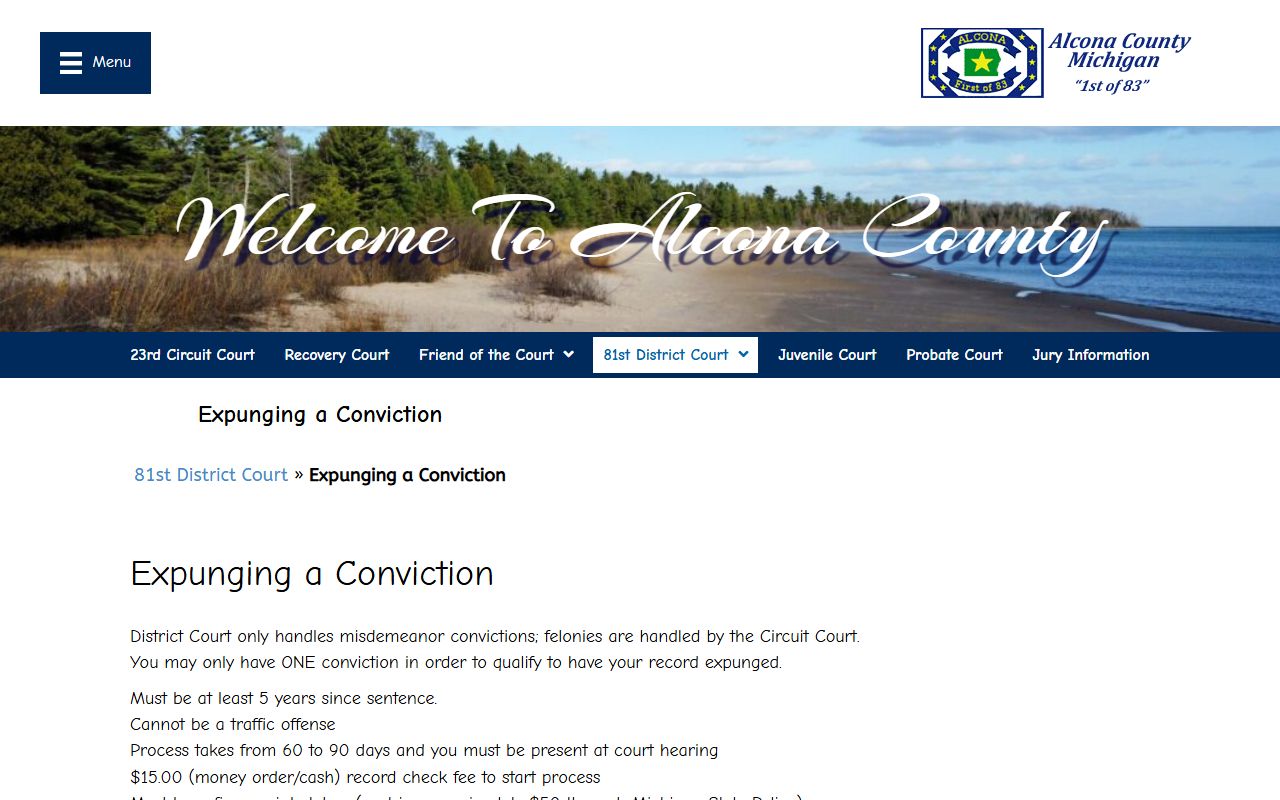
The county guidance lays out the burdens plainly. At least five years must have passed since the sentence. The offense cannot be a traffic offense. A $15 record-check fee starts the process, and fingerprints cost about $50 through the Michigan State Police. The process runs 60 to 90 days, and the applicant must be present at the hearing.
The legal engine behind all of this is the set-aside act. Its core provisions are found in the statute the state maintains online.
The main set-aside statute is MCL 780.621, which sets eligibility and the waiting periods for clearing a conviction.
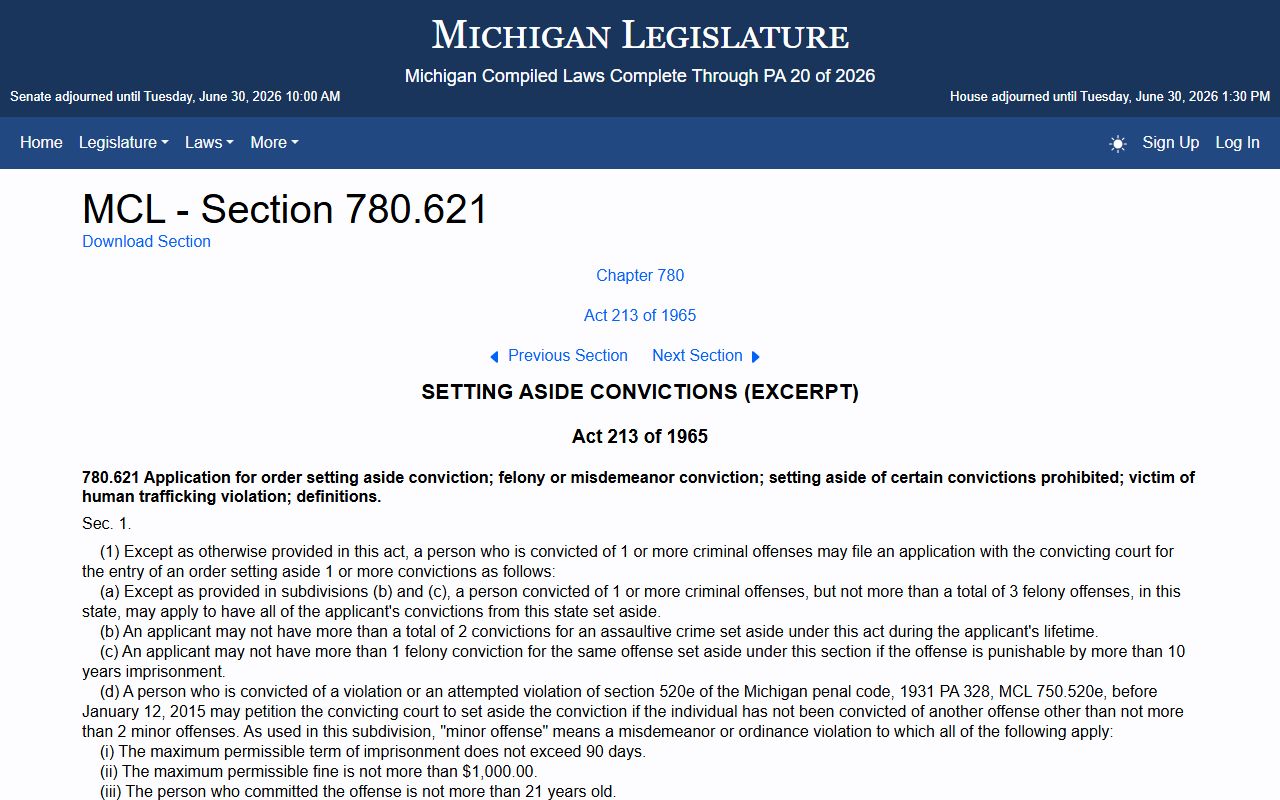
Reading the statute alongside the county checklist gives a realistic picture before filing. A set-aside record is not the same as an ordinary public court file; once a conviction is set aside, access to that file becomes much more limited. For hearing dates and case status while a petition is pending, the county's court dockets are the place to check.